This post is about the last part of my motorcycle trip in April 2025. Having traveled the Canary Islands for about two weeks, I returned from Lanzarote to the Spanish mainland. Followingly, I traveled through Portugal and the north of Spain back home. Find out more in the post below!
Cádiz to Faro
After another long ferry ride, I got back to the Spanish mainland in Cádiz at about 9:00 am. At this point of the trip, I had about 10 days left till I had to be back at home. The plan for the remainder of the trip that I had been thinking about while I was traveling the Canaries was the following: head west to Portugal’s Algarve coast, then make my way north through the country, stop to see some places until I get to Porto, which I decided I wanted to visit as well. Then figure out a way home from there. I decided not to go to Lisbon since I’d rather spend the time I had left traveling through the country rather than visiting a big city.


Following a coffee in the old town of Cádiz (which lies on a rock island connected to the mainland via dams and bridges), I rode towards the west into Portugal, stopping in Faro. Faro is the capital of the Algarve region and, with about 45’000 inhabitants, a smaller city with a marina at its beachfront and many cultural attractions. Since I was pretty tired from the ferry crossing, I stayed at a hostel close to downtown for two nights. On my off-day (not riding my motorcycle or a ferry for the first time in a while) I went to Faro’s municipal museum and its maritime museum. The municipal museum houses mainly art exhibitions, while the maritime museum is made up mostly of ship models. At the time I visited, the municipal museum hosted an exhibition of the work of Nadir Afonso, a Portugese architect and painter who was mainly known for his paintings containing geometric shapes.


As I was taking a break from motorcycling for the day, I was thinking about which route to take to see more of Portugal. A popular road with motorcyclists is the N2, which crosses the country from North to South through the hilly and in some sections mountainous heartland. While this would certainly have been a great option, I longed for some off-road tracks, as I’d heard Portugal is an ideal place for off-tarmac riding. While I was aware that there was an extensive Trans Euro Trail (TET) running from North to South, I had also heard that it was in some sections a pretty hard trail, and therefore not the right choice for me alone with a heavy adventure bike. After some research and tips from the TET Facebook group, I quickly pointed my attention to the Portugal edition of the Adventure Country Tracks (ACT). In its essence similar to the TET, it is an easier track, still mostly composed of dirt roads but without any sections that are too technical.
Riding the ACT
The next day, I set off towards the North. Riding a bit of the N2 (which has its southern end in Faro) at first, I cut into the ACT after about an hour of Tarmac riding. From there on, the track follows mainly easy-to-ride forest service roads, climbing and descending many little hills. Occasionally, some smaller creeks needed to be crossed.


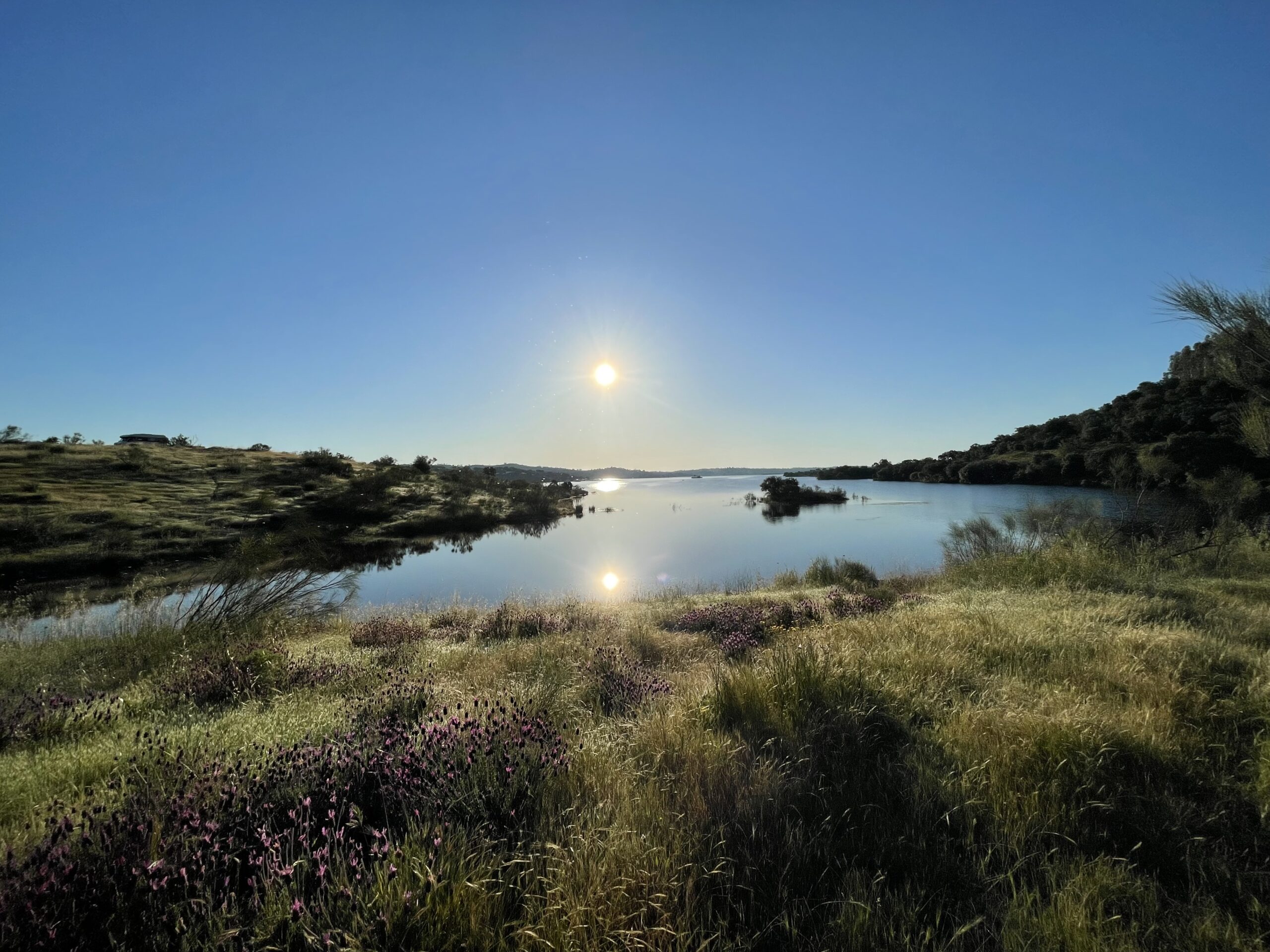
After a lunch break in Mértola, I continued riding on the ACT. It didn’t take long until it reaches the abandonned Sao Domingos mine near the Rio Chança, the river which marks the border between Spain and Portugal. Following the track further towards the north, I kept riding before eventually setting up my tent at the Albufeira de Alqueva reservoir. For the first time on this trip, I did actually get to use my camping gear. The camp spot couldn’t have been better: a nice calm place right on the lake, with a good view of the sunset and the sunrise the next morning. Fortunately, I also profited from the impeccable weather, albeit it was somewhat hot during the day (despite it being only mid-April). I was the only person staying there except for a man from Germany with his RV, who had been traveling solo with his two dogs for a couple of years, which I learned while talking over a beer as the sun went down.


After waking up to the sun rising over the lake, I continued my way north on the ACT. Actually, the ACT Portugal is segmented into 5 stages, with the total length of the track being about 1200 km. However, you can of course set your own daily goals and either find accommodation in the towns it passes through, or find a nice camp spot along the route. I used iOverlander and park4night to help me with the latter. The section I rode on that particular day had quite a bunch of wet spots, which must have been caused by rainfall in the last couple of days and weeks. However, by looking at the map to avoid some of the worst ones I was able to keep following the track and luckily I didn’t get stuck anywhere. The day ended with another night of camping, this time at the Tagus river near Gavião.


Nazaré and Porto
The following day, I decided to veer off the ACT and head west towards the coast. I wanted to see Nazaré, a town on the Atlantic Ocean popular with tourists and surfers alike. Surfers enjoy the spot because of seasonally occurring giant waves that can be well over 20 meters tall. After visiting the Miradouro do Suberco viewpoint, which offers a great view of the town and its beach, I subsequently continued north, riding on the Estrada Atlântica, following the coastline. After passing through Figueira de Foz, I concluded the day by staying at a hostel in Esmoriz, which is about 25 km south of Porto.

After washing my clothes and my bike (the muddy spots on the ACT made sure it desperately needed a wash) the next morning, I headed into Porto, where I checked into a hostel. Leaving my stuff at the there, I went into the city on foot and by bus for some sightseeing. Porto has plenty of spectacular architecture, especially churches and bridges that cross the Douro River. I was particularly impressed by the Sé do Porto cathedral and the Ponte Luís I bridge.


Northern Spain and the way home
Leaving Porto the day after exploring it on foot, I intended to head north out of Portugal and into Spain’s Galicia region. From there, I would follow the northern coast of the country, eventually crossing into France and then heading home. I had five days left to follow through on this plan. First, however, I stopped in Guimarães and met up with Miguel, who I’d gotten in touch with via Facebook when I was asking about ideas for off-road riding in Portugal. Miguel is a fellow adventure rider and he turned his passion into his profession, as he offers guided tours around his home town and country. Miguel gave me an educational tour of Guimarães, explaining to me the historical significance of the town while we were riding around on our bikes. The knowledge about tracks and places of a local guide can prove invaluable when exploring unknown places, feel free to reach out to Miguel if you intend to travel Portugal by motorcycle.


After learning many things about Guimarães and Portugal in general from Miguel, I rode into Galicia on scenic mountain roads. Eventually, I arrived in A Coruña, in the very northwest of Spain, where I stayed at a campground. The following morning, I went into the city center of A Coruña for a coffee before continuing east on small roads along the coast.


The coast consists of many small bays and little towns, very enjoyable for motorcycling, however I had to skip some sections in order to keep making progress towards home. In the afternoon, I got to experience the widespread blackout that hit Spain on that day, as most cafés and restaurants were closed. After riding through little coastal towns like Cedeira and Cariño, I took the A-8 freeway from Foz to Perlora near Gijón. There I stayed at another campground, this time right by the sea. Street lights came back on as nightfall progressed, indicating that power had been restored. However, too late for hot water the next morning though, which meant I got to enjoy a refreshing cold shower…


Leaving camp, the final place to visit on my agenda for this trip was the Picos de Europa national park. The area is very popular with motorcycle riders, and after seeing it for myself, I can understand why. Windy roads mixed together with spectacular views of the peaks, it’s a picturesque area to explore by motorbike. Especially bike travelers from the UK took a liking to the area, as there are ferry routes connecting England and Ireland to northern Spain, making for an easy journey to get there. With not that much time left, I only did what could be called a “basic tour” of the mountain range, riding the N-625 from the coast to Riaño, and returning farther to the east via the N-621. In the evening, I rode to a hotel in a suburb of Santander, where I spent my last night in Spain on this trip.


Over the course of the next two days, I covered the roughly 1400 km from Santander to my home on freeways. Crossing into France at the border near Donostia-San Sebastian, then continuing via Bordeaux, Clermont-Ferrand and Besançon, I was back at home 30 days after I left off.

All in all, it was a fantastic trip. My longest motorcycle tour yet, I got to see lots of beautiful places and to meet many friendly and helpful people. I have many more ideas for motorbike trips, regions that I haven’t been to yet but want to travel some day. I’m eager to embark on the next journey as soon as my work schedule allows it. Thanks for reading!