Before heading out on our journey, some bike prep was needed. I started by giving my KTM an oil change and changing the air filter. Then it was time to install some aftermarket parts that help the bike cope with longer desert rides. This included a larger-capacity fuel tank that my dad already owned, a small tank bag and tail pack. I also installed a sand filter cover for the air filter as well as my Garmin GPS mount. Furthermore, a friend kindly helped me with a few additional repairs such as changing a wheel bearing and mounting two brand new tires with mousse inserts. With a general-purpose Michelin Tracker tire in the front and an aggressive Mitas tire with large knobs in the back, in conjunction with firm mousse inserts the bike should have no problem enduring hundreds of kilometers of rocky terrain and sand dunes.
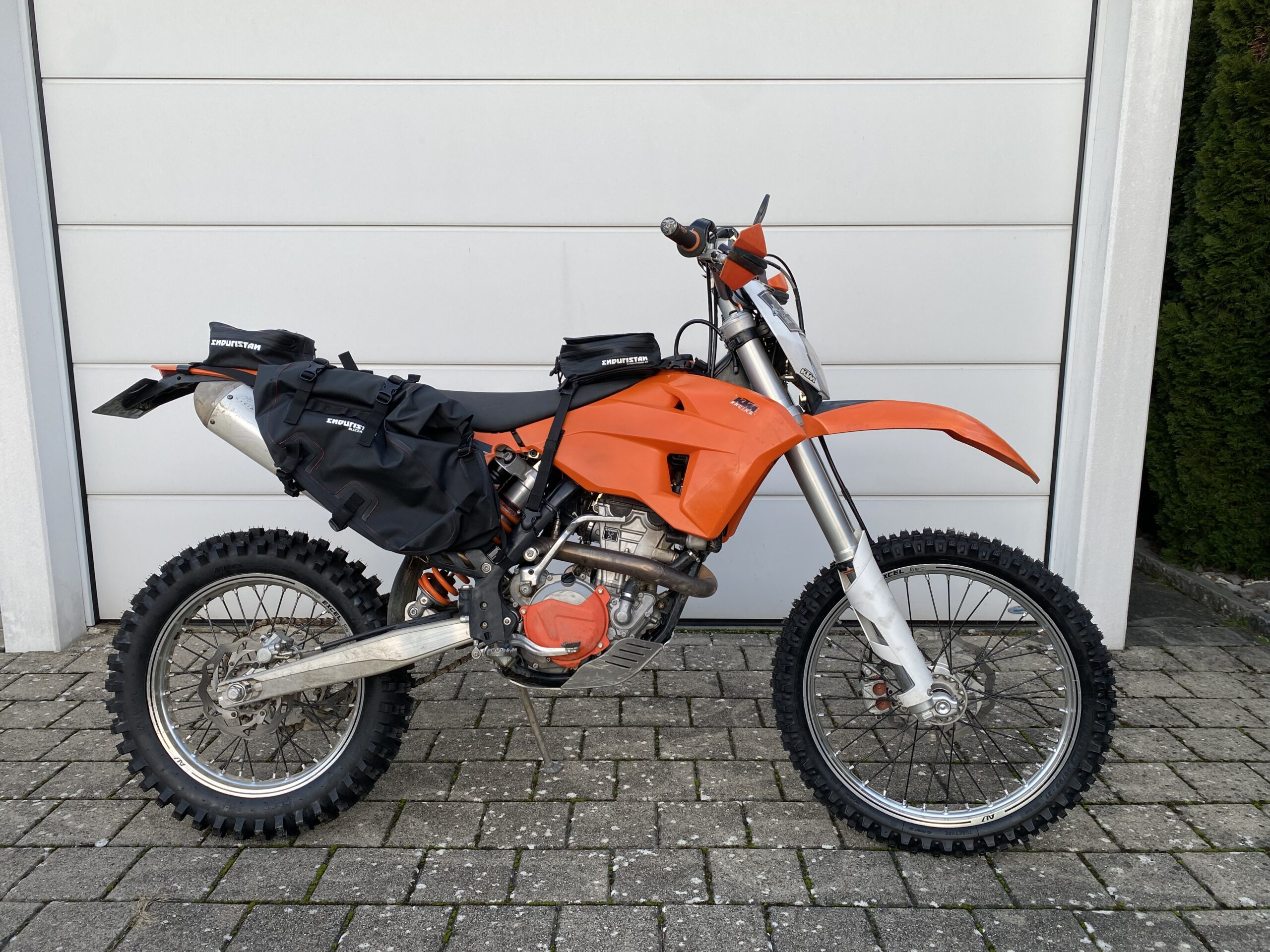
With my dad having completed much of the same prep work on his Husqvarna FE 350, on December 27th, 2023 it was time to pack our gear and head out. We loaded the bikes and everything that we could possibly need during the next two weeks into my Sprinter van. With the intention of driving the van to Douz, which is on the north end of the Tunisian Sahara desert, we made our way to Genova, where we boarded the ferry to Tunis, the capital of Tunisia located on the Mediterranean.

After about 24 hours on the ferry, we arrive at the port of Tunis. Immigration and leaving the port took about an hour, bringing a vehicle plus two motorcycles to the country requires filling in various forms with details like VIN numbers, license plate number and so on. Handing over a small stack of papers, the customs officials agree to let us out of the port. Since the ferry arrived in the evening, we only make a quick stop at an ATM to grab some local currency and drive about 100 km to Hammamet, where we have made a hotel reservation.

The next day, we set off for the approximately 500 km to Douz. Before doing so, we stop at a cell phone store where I purchase a SIM card, so that we have access to the Internet during our trip. Little do I know at the time of leaving the shop that I have forgot my passport there. This only comes to my attention after having arrived in Douz half a day later… Through some e-mails, phone calls and the help of very kind store employees I was able to recollect my passport on the way back about 10 days later. In Douz, we set up our base for day trips on the bikes.


Our first day trip on the bikes took us to Ksar Ghilane, an oasis about 80 km southeast of Douz. The place has lots of palm trees providing shade, however, it was also very busy with tourists engaging in ATV and camel riding. We stopped for lunch and decided to have a look at the nearby ruins of Castellum Tisavar, which was once a border post on the southern end of the Roman empire. On the way there, we ran into a group of Austrian travelers with ex-army vehicles converted into overlanding rigs. We chat with them for a while (my dad owns a expedition truck very similar to one of theirs) and eventually head back to Douz, witnessing a spectacular sunset before we reach the town.


The next day, we had planned another day-ride into the desert. Before following a GPS track leading us through the desert, we rode from Douz to El Faouar on the paved road connecting the two towns. From there, we left the pavement and followed the GPS track, which at some sections was quite challenging since the wind and rain had washed away any tracks of vehicles that had followed that route before us. At some point of trying to find the best way through the sand we ran into a couple of wet spots, one of them I saw too late and my bike got stuck badly. It took us three quarters of an hour of digging by hand before we were eventually able to yank the motorcycle out of the hole it dug itself into. Thinking that doing this ride would only make sense if conditions were sufficiently dry, we called it a day and retourned to El Faouar for some sandwiches and coffee. After that, we rode back to Douz and cleaned our bikes and gear from the sticky wet sand they were covered in.


The next ride we had planned was a bit more of an adventure, with the idea being to ride to Tembaine and then continuing to Lac Houidhat Erreched and back to Douz from there, which would take us three days. Since my dad caught a cold we had to stay at our hotel for a couple of days before heading out, celebrating New Year’s in between. With my dad feeling better again after resting a few days, we packed our sleeping bags, some spare clothes and some essential tools for the three-day ride. The first day we covered the roughly 110 km on pistes and through sand dunes to Tembaine. The term “Tembaine” translates to “the mountain seen from afar” in the local Berber language and it easy to tell why it ended up with that name, it is the only (small) mountain in a vast area of dunes. Around the mountain, there are two desert camps with tents where tourist can stay at. We had made a reservation to stay at one of them for two nights, so we could ride to Lac Houidhat Erreched and back the next day, and stay once more before returning to Douz. Importantly, we had also coordinated with the owner of the camp the ability to buy some fuel. Sitting by the fire, eating some very tasty food at the camp’s restaurant we ended the first day before sleeping in one of the tents at the camp.


The next day, we set out on the 45 km ride to Lac Erreched, which is also known as the “Lost Lake”. It is a source of hot water in the middle of the dry desert. The size of a couple of football fields, it is a popular spot for 4×4 and adventure tourists. The track leading us there is not too hard for light dirt bikes, albeit it contains some steep bits and some sections where it can be difficult to find traction and maintain momentum to climb the sand dunes. We got there after a couple of hours of riding, stopping frequently to determine which path we should take around some of the steeper dunes. After we got there, we rested for about half of an hour, enjoying a well deserved Coke at one of the little bars selling drinks at the lake. After taking some photos, we decided to try to get back to the camp somewhat quicker than on the outward journey, so that we would get back before dark.


After staying one more night at the camp we made our way back to our hotel in Douz, where we would stay one more night before loading our bikes and equipment into the van and getting on our way back to the ferry in Tunis.


On the way back to Tunis we spent one night in the coastal town of Mahdia, followed by another in Hammamet (where I was able to get my passport back), before our last night in Sidi Bou Said, near the historic town of Carthage. Carthage is nowadays part of Tunis, containing several historic sites dating back to the Punic and Roman empires. We had a look at some of the sites, such as the baths of Antonius and Byrsa Hill, before heading back on the ferry the next day. With the ferry arriving in Genova at about 14:00 the day after leaving the port in Tunis, we were able to drive home in the afternoon of the same day, concluding the trip.


