In September 2024 I went on a two-and-a-half-week motorcycle tour to the southeast of Europe. I first rode to southern Italy, then took a ferry from Bari to Durrës (Albania), from where I headed further south to Greece. I rode about 6000 km on my Yamaha Tenere 700, this has been my longest motorcycle tour yet.
The trip started out with me leaving home in the afternoon, with the intention to get across the Italian border before staying somewhere for the night. This plan I put into action through riding over the Splügenpass and then staying in Chiavenna.


The next day, my idea was to cover some miles on the Autostrada to get further south. Unfortunately, between Milan and Bologna it was raining heavily, and my gear was put to the test. While I stayed (relatively) dry, water got into the bag with my camping gear, meaning that I had to lay out most of its contents to dry in the tiny hotel room in Pedaso (about half way between Ancona and Pescara), that I was staying at the next night.


Leaving the Adriatic coast, I headed into the hills of Abruzzo. The rain had vanished and I got to enjoy the twisty roads. I stopped to get some lunch in the region’s capital, L’Aquila. In many of the area’s towns and villages, lots of construction cranes and reconstruction efforts show that the damage caused by earthquakes is all but forgotten. Two major earthquakes in 2009 and 2016, resulted in hundreds of casualties in L’Aquila and Amatrice, respectively. Heading further southeast, I ride through the Fucino plain. What is now a plain measuring about ten by twenty kilometers, used to be a Italy’s third largest lake until the 19th century. Already the ancient Romans attempted to drain the lake by building a tunnel, with the intention to open up the land to agriculture and get rid of Malaria. However, complete drainage was only achieved in 1878, after a new tunnel designed by a Swiss engineer had been built. I continued riding for another bit, passing through Castel di Sangro before staying in the historic center of Agnone.


Meanwhile, I discovered that the new helmet I purchased before going on the trip doesn’t fit me properly and I get a headache from wearing it. Having made the decision that I’m not able to wear the helmet for the remainder of the trip, I decided to ride to Bari, a major port city on the Adriatic coast in southern Italy. Luckily, the WheelUp store (a motorcycle clothing store franchise in Italy) in Bari has lots of helmets and I was able to buy one that fits me.
Since I didn’t want to carry the other helmet on the back of my bike for the next two weeks, I decided to mail it to Matteo, a friend who lives in northern Italy and kindly agreed to store the helmet for me until I was able to pick it up. Since Switzerland is not part of the European tax-free area, sending it to him and picking it up sometime later was the easier option than sending it home. It was Saturday noon when I purchased the new helmet, and since every post office was just closing at this time for the weekend, I asked the store to hold on to the other helmet until Monday, when I would return to Bari and take it to the post office.
With the helmet situation fixed, I left the coast again and drove through little old towns such as Irsina, taking a somewhat unwanted shortcut on a gravel road (there was a mud pit at the end of it that I almost got stuck in) before staying in a hostel in Matera. At the hostel, I met two young Englishmen who were traveling from Georgia to Sicily on their touring bicycles. Looking at the minimalist gear they were packing for their long trip, traveling by motorcycle all of a sudden felt quite luxurious…


The next morning, I rode up to a small hill that offered a nice view of Matera’s historic city center. Many of the buildings were directly cut out of the naturally occurring rock. The cave dwellings are called the Sassi di Matera, and there is evidence that humans started living there almost 10’000 years ago.
I leave Matera behind and after a while of riding, I notice that I must have lost my fender bag with a spare tube and pump in it somewhere on the gravel road that I rode on the day before. As I wasn’t too far away from that spot yet, I decided to return to the gravel road and start looking for my lost bag on foot, since I did not want to ride through the mud pit again. I eventually found it after walking along the gravel road for quite some time… In the evening, I rode to the southern coast and set up my first camp on this trip, right on the beach not far from Taranto. The beach is probably pretty busy during the holiday season, however when I was there to spend the night, I was only joined by a couple of motorhomes and it was a calm spot.


Waking up to an intensifying breeze and clouds forming in the sky, I hurried up to pack up my tent and headed back to the WheelUp store in Bari, where I took my helmet to the post office. I decided to park my motorcycle somewhere near the port and take a look at Bari. There were lots of tourists, the narrow alleys and the dome I certainly found interesting, but after an hour or so, I had seen enough…


Thinking about where I wanted to go next, I booked a ferry that would take me from Bari across the Adriatic Sea to Durrës, Albania, in two days’ time. I decided to use the two days I still had left in southern Italy to go to the very south of the Apulia region, which is also called the Salento peninsula and the “heel of the boot”. I stayed one night in Brindisi, before riding along the coast to Santa Maria di Leuca, the southernmost point of the peninsula. I stopped at various lookouts and ancient ruins on the way before heading back to Bari to catch the ferry to Albania in the evening.


There were not many people on the ferry and it was easy to find a more-or-less comfortable spot to sleep on the floor somewhere in the seating area. The ferry arrived at about 8:00 the next morning in Durrës. Since I didn’t think too much about where to go in Albania before getting there, I first decided to grab a coffee close to the port in Durrës. I quickly realized how friendly people were and how inexpensive things were compared to what I’m used to, and even compared to southern Italy. After looking at the map for a while and thinking about some possible routes that include gravel roads, I decided to head inwards to Elbasan and then head south from there, taking a gravel road that is part of the Albanian TET, if it was rideable for me on the loaded Tenere. Luckily, this TET section was pretty easy but worthwhile nonetheless, with some nice views along the way. I cut back into the paved main road SH-71 near Gramsh. I followed the same road along the Devoll river and stopped every few kilometers to take pictures of the amazing scenery. In some sections, the river and the road run through a steep canyon, and the twisty parts of the road resemble alpine passes. I kept going until I ended up in the Korçë plain and it got dark and chilly, at which point I went to a hotel near Korçë. The owner of the hotel was very friendly and helped me maneuver the bike into his small garage in the backyard. It was a simple hotel, but it had all the amenities such as a hot shower, and at 20 Euros, it probably was one of the cheapest hotel rooms that I ever stayed at…


The next morning, I headed north to Pogradec, on the southern shore of Lake Ohrid. Lake Ohrid is located on the border between Albania and North Macedonia, according to Wikipedia it’s one of the oldest and deepest lakes in Europe, and the North Macedonian side is an UNESCO World Heritage site. Since I wanted to head south towards Greece instead of going north, I didn’t go further along the lake than Pogradec, but instead left eastern Albania and crossed into Greece at the border in Krystallopigi. From there, I took the freeway to Grevena, continued by riding to the Meteora monasteries after my first Gyros lunch on the trip. After looking at the monasteries dating back to the 14th century that are built on rock pillars, I continued south on the brand-new-looking E65 freeway and set up camp at the thermal baths in Thermopylae, near Lamia. The location of the thermal baths is of historical significance since in 480 BC, the Battle of Thermopylae between the Greeks and the invading Persian Empire took place there.


The next morning, I continued on the main road, now through the mountains, towards the Gulf of Corinth. I stopped a few kilometers after leaving my camp spot at a gas station café where I met a group of Greek motorcycle riders. One of them spoke English fluently and gave me some tips on where to go in the south, he himself had traveled all over Europe, as many stickers on his Honda Pan European showed. I continued through the mountains until I reached the Gulf of Corinth, from where I crossed the Rio-Antirrio bridge, which is 2.5 kilometers long and was opened in 2004, connecting the Peloponnese to mainland Greece. I kept going somewhat further on the west coast, and decided to camp near Olympia after looking at the port of Kyllini.


A short but nevertheless intense rain shower right as I was setting up camp that night put my tent to the test, but luckily I stayed dry. The next morning I went to Zaharo for a coffee before visiting the archeological site of Olympia, where in ancient times the Olympic games took place every four years. The ancient site is very impressive, as it contains lots of old buildings and many of their ruins survive to this day. In the afternoon, I visited the Voidokilia beach. Despite it being very beautiful and scenic, I didn’t spend a lot of time there as it was packed with people on this Saturday afternoon, but instead headed to Kalamata. I went to a car wash where I took the time to thoroughly clean my bike, getting all the dirt off that was still on there since I rode through the mud in Italy. I found a small hostel in the old town of Kalamata, where I met Georg, a young German carpenter, who had been traveling on foot through the Balkans for the past year.


I decided to book another night at the hostel and use the next day to explore Kalamata on foot and do a day ride to Sparta, leaving my luggage at the hostel. After looking at ancient Sparta, which is smaller and less busy than Olympia but impressive nonetheless, I subsequently went south to see the Dimitrios shipwreck, a rusty old ship stranded on a beach. I looped back around through Gytheio and then along the west coast back to Kalamata. Before getting into town, I rode a scenic gravel road with lots of switchbacks where on top a very nice view of the coast and the setting sun awaited. Riding the twisty gravel road was definitively a lot easier without any luggage on the bike.


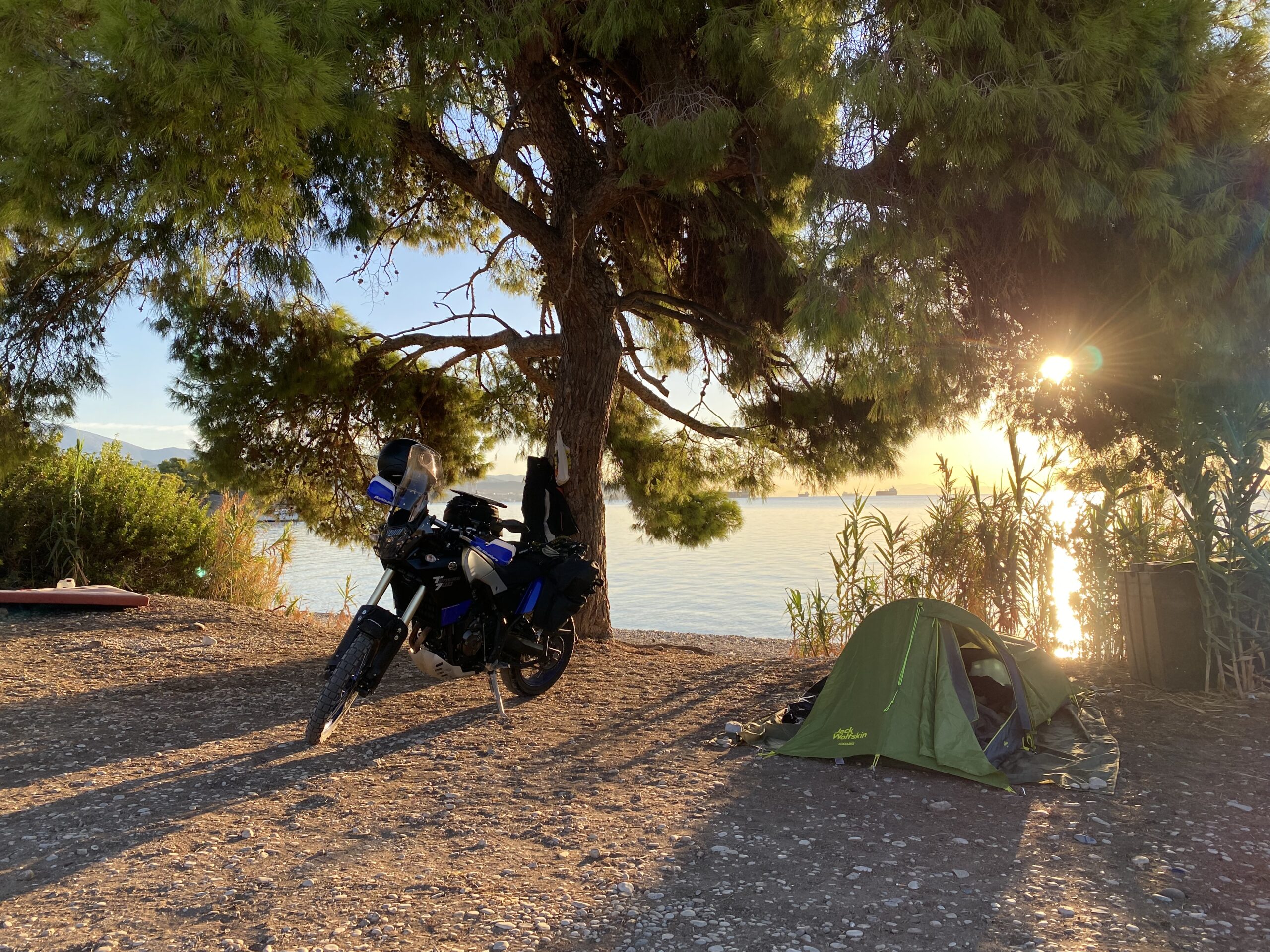
After spending another night at the hostel, I decided to look at the Methoni and Koroni castles in the southwest of the Peloponnese, before starting to head north. The two castles were built in the 13th century by the Venetians and served a strategic role in trade and the defense of their empire. I spent the rest of the day riding across the Peloponnese peninsula, riding northeast through Tripoli and Nafplio before setting up camp on the beach near the Canal of Corinth. While it was a calm and peaceful camp spot, I ran into some friendly people. First I talked to Ioannis, a local history professor and book author who educated me lot on Greek history and architecture. Then, a German couple in a Land Rover arrived and decided to make use of the nice camp spot as well. Kai and Sarah with their dog Vincent had been travelled full-time for three years, covering the entire Panamericana from Alaska to the south of Argentina and were on their way home from Georgia. Initially, didn’t want to go into Athens but they convinced me to do so anyway, which I did the next day.


After waking up to the sun rising over the sea, I made a first quick stop at the Canal of Corinth and then navigated through the dense traffic into Athens. I left the bike at a downtown parking area Sarah and Kai recommended, within a few minutes of walking distance to the Acropolis. They also recommended booking the entry ticket online for a selected time slot, which I did, but that didn’t change the fact that there was a long queue to enter the famous ancient site. It was worth it anyway, the Acropolis is indeed very impressive and there is a great view over the huge city of Athens from the hill it was built on. Leaving Athens, I intended to make some northbound progress. Unfortunately, I didn’t get very far before the heat in Athens was replaced by pouring rain, which led me to seek refuge in a hotel in Arkitsa, which is on the coast adjacent to the island Eubeoa.


Since lots of rain was forecasted for the coming days over the entire Balkan peninsula, I abandoned my plan to ride home through the Balkans but chose to take a ferry to Italy instead. Luckily, I was able to book one that would sail from Igoumenitsa to Ancona on the evening of the same day that I left Arkitsa. Leaving rainy northern Greece behind, the ferry arrived in Ancona the next afternoon. The rather boring 20-hour ferry trip was made considerably more interesting since I talked to Austin and his friend Jerry, who were on their way home to Ireland from a motorcycle trip all the way to Istanbul.
Arriving in Ancona, the weather wasn’t any better than in Greece. Inundated fields and parking lots indicated that there must have been excessive amounts of rain in the last couple of days or weeks. I stayed in a hotel in Cattolica before making my way home the next day. Rather by accident than by planning to do so, I went into Modena and visited the Pagani museum, which tells the history of the Italian manufacturer of ultra-high-end sports cars. Funnily enough, as I left the museum, the iconic founder Horacio Pagani himself greeted a visitor group at the entry of the premises. Arriving at home in the afternoon, this concludes my two-and-a-half-week trip.
