The following is a summary of a motorcycle trip that I took in April 2025. I was by myself on my Yamaha Tenere 700, and rode about 8’500 km in 30 days. I first rode to the south of Spain to catch a ferry to Tenerife, followed by island-hopping all but one of the islands belonging to the Canary Islands archipelago. After returning back to mainland Spain, I subsequently headed west to Portugal, from where I made my way north through the highlands, then to Nazaré and Porto on the Atlantic coast. Finally, I rode through the regions Galica, Asturias and Cantabria in northern Spain, visiting also the Picos de Europa national park.
After having spent almost three months in Gran Canaria in 2021, it has always been an idea of mine to one day come to Gran Canaria and the other islands that are part of the Canary Islands archipelago with my own motorcycle.
During my stay in GC a few years ago I learned that the island is a fantastic place not only for mountain biking, but also for motorcycling. While the Canary Islands are not that far away from mainland Europe if visited by airplane (about 4 h 30 min from Zurich), getting there by road and ferry takes a lot longer. First, there is a long motorway journey from Zurich to the port of Huelva or Cadiz, which is about 2200 km. Then, to get from the Spanish mainland to the islands, you take a ferry to Tenerife (connections to the other bigger islands exist as well) which takes roughly 35 hours. The reward, however, is that you can not only explore Tenerife with your own vehicle but quick and convenient ferry connections to all of the other islands are at your disposal as well.
The way to Tenerife
The time to put this idea into actuality came in spring 2025, when I decided to leave my current job at the end of March, and to start a new job at the beginning of May, leaving me a month to travel. The journey began from my home in northeastern Switzerland on the 2nd of April. The plan was to get to Huelva as quickly as possible, so the first part of the trip I did not veer off the highway and I got to Huelva in three days, just in time to board the ferry to Santa Cruz de Tenerife.


The 35 hours on the ferry were okay, however, not the most comfortable as I had not booked a cabin (a ferry ticket including a cabin would have been more than double the price), taking my sleeping bag on board instead. On the ferry I met Evelyne and her close friend that she was traveling with, she was very generous and brought me some food from the buffet and let me use the shower in their cabin, which I was very thankful for. The ferry’s arrival was delayed by a few hours (likely due to a massive storm in the Atlantic, which also resulted in some severe rain on the Canaries the following days), meaning that it arrived in Santa Cruz at 2:00 am. Fortunately, I had booked a hotel with a 24 hour check-in beforehand, only a short ride of a few kilometers from the port through the empty nightly streets of Santa Cruz.


Tenerife
The first few days on Tenerife, I stayed in Santa Cruz and did some riding and sightseeing. The already mentioned rain slowed me down a bit on the intended schedule, this wasn’t bad though, since I enjoyed staying in the town a few days. Santa Cruz de Tenerife, while it is a busy city by my standards as somebody used to rural living, is very walkable and clean, and there are many small parks and squares. There is even a streetcar line, which is the only railway on the Canaries. Other interesting things to look at are the auditorium and the botanical garden.


In terms of motorcycling, a nice ride (on a clear day) is the TF-21 through the mountains, bypassing the 3715 m tall Teide volcano. Also, the narrow and twisty road through the Parque Rural de Anaga is worth a visit. Of course, I was also in search of some dirt roads. With the help of Wikiloc I was able to find some nice unpaved roads, one that I particularly enjoyed goes from Guimar up to the Izaña observatory.


As the weather improved after a few days, I moved from the hotel in Santa Cruz to a hostel in Los Cristianos, in the southwest of Tenerife. I had a fun time there talking to other travelers from Europe, Asia and North America.
Furthermore, while I stopped at a scenic spot somewhere near Los Cristianos, I was approached by Walter and his girlfriend, a couple from the Netherlands who just got to the island for a one-week holiday. Walter told me that he had plans to rent a motorcycle the next day, so we met up for a ride at a motorcycle rental place the following morning. Canary Ride have a diverse fleet of modern bikes with both an office in Tenerife and another one in Gran Canaria, at the latter I had rented a Yamaha Tracer 700 on my trip back in 2021. Together with Walter I went once again up to the Teide, this time in better weather and better visibility. Only coming down towards the north coast we had to cut through very thick fog, but this is nothing unusual in the region.


La Gomera
The next day, I went on a day trip to the closest neighboring island, La Gomera. It is an easy trip since the ferry ride from Los Cristianos to San Sebastian de La Gomera takes only one hour, and multiple connections every day are available, so you can head out in the morning and be back in the evening. La Gomera is a lot smaller than Tenerife, the landscape is very rough in the sense that there are a lot of peaks and valleys, and basically no plains. The weather behaves accordingly: sunny and warm, albeit a bit windy, on the coast; cold and drizzling in the mountains. La Gomera only has about 22’000 inhabitants and there is no mass tourism like there is on Tenerife and Gran Canaria. I enjoyed the day exploring the islands spectacular views and great motorcycling roads, but it wouldn’t be my favorite place to stay for a longer stay.


La Palma
Coming back from La Gomera and staying another night at the hostel, I decided to move to La Palma next. La Palma is roughly twice the size of La Gomera and located in the northwest of the archipelago. The ferry crossing from Los Cristianos to Santa Cruz de La Palma took two and a half hours.
I stayed in a hotel in the old town of Santa Cruz for two nights, which allowed me to spend two evenings walking around town and get a full day of riding. With about 13’000 residents, Santa Cruz maintains a small city atmosphere even though it’s the island’s capital. The only place reminiscent of a busier modern city is perhaps its port, as cruise ships stop there frequently and the island’s only McDonald’s is found there.


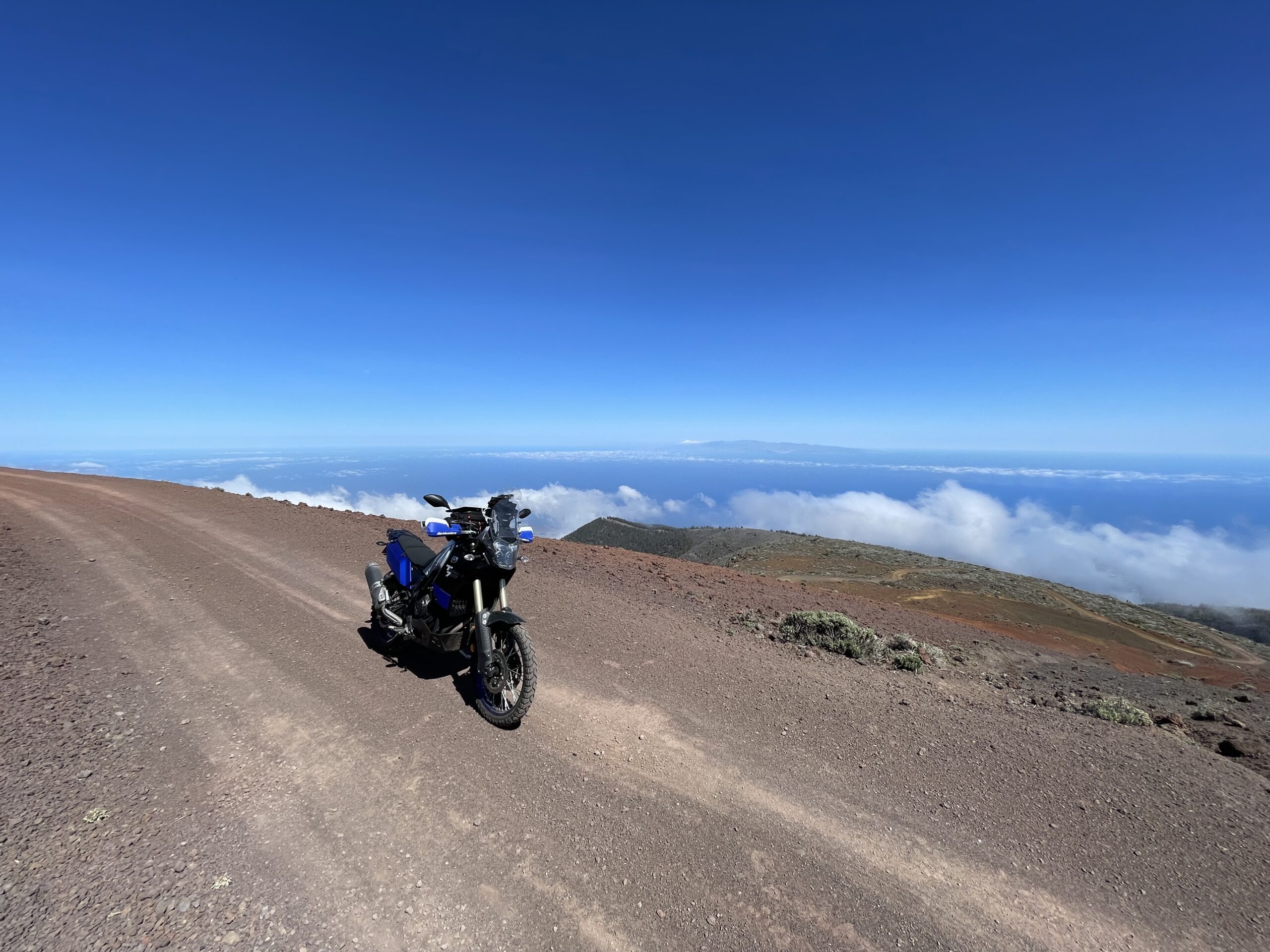
The weather was sunny and warm as long as you stayed close to the coast. Riding on LP-1 and LP-2, it’s possible to ride around the island following its coastline. This turned out to be the right thing to do, as you get to take in lots of the island’s spectacular scenery, and it’s easily doable in a day with time for stops. I took a detour towards the islands mountainous center but returned to the coast at the next possibility since it got foggy and chilly quickly. With more time available and better weather, I’m sure it would be worth riding to the national park in the mountains. While La Palma looks like a peaceful nature paradise to unassuming visitors, the major damage to the area south of Los Llanos should also be mentioned. In 2021, the most damaging volcanic eruption ever recorded on the island destroyed entire towns and parts of the coastal road. The aftermath of the eruption will be visible for many generations, despite reconstruction efforts of the lost neighborhoods being underway.


In summary, I really liked La Palma. The island is a lot less touristy than Tenerife and Gran Canaria, with virtually no large hotel blocks. By no means does it feel abandoned or boring though, with its small but charming capital and spectacular views all around the island it indeed is a really interesting place to visit in my opinion.
More to come: This marks the end of the post for now, I went back from La Palma to Tenerife. Then to Gran Canaria, Fuerteventura and Lanzarote, before heading back to the mainland. Stay tuned for complete trip summary. Thanks for reading!