In this part of the blog I pick up where I left off in the last post: having explored Tenerife, La Gomera and La Palma, I headed towards the east of the Canaries archipelago. Visiting Gran Canaria, Fuerteventura and Lanzarote before heading back to the Spanish mainland, I spent another couple of days touring the islands with my motorcycle.
Gran Canaria
After only one-and-a-half days on La Palma (I’d loved to stay longer had I more time available), I got on the early morning ferry back to Tenerife. My plan was to now start making my way east on the Canary Islands archipelago, to eventually catch a ferry back to the mainland from Lanzarote, the most eastern island. Since I’d already spent a few days on Tenerife I simply rode from Los Christianos in the southwest to Santa Cruz, from where a ferry connects to Agaete on Gran Canaria.

Arriving on Gran Canaria in the afternoon, I made my way to Los Cristianos in the south, where I had reserved a room for the night. Since I’d already explored the island on rental motorcycles during my stay a couple of years ago, I decided to only spend a single day on Gran Canaria before heading on to Fuerteventura. Of course, I would have like to spend more time there as well, but this way I could spend more time on Fuerteventura and Lanzarote before heading back to the mainland. The day I spent on Gran Canaria was very enjoyable though, I got to ride my favorite roads with my own motorcycle and was once again intrigued by the view from Pico de Las Nieves, the highest mountain on the island. I also looked at the old town of Teror, with its remarkable church “Nuestra Señora del Pino”. Towards the evening, it was time to head to the port in the capital, Las Palmas, to board the ferry to Fuerteventura.


Fuerteventura
Arriving in Morro Jable in the very southwest of Fuerteventura at about 9 pm, I still had to ride about 1.5 hours to an Airbnb I’d booked near Puerto del Rosario. Fuerteventura is very different from Gran Canaria, there are no bigger mountains and pretty much all of the island is desert area. I had some memories from a week-long trip to the island together with my mom, which was about 10 years ago. For the two days I was staying in Fuerteventura I had booked a room at an Airbnb near Puerto del Rosario, hosted by a yoga instructor named Iago.
The next day, it was time to do some housekeeping once again. First, I went into town to get my clothes washed, followed by some riding on an off-road track in the afternoon. Knowing that most of the terrain in Fuerteventura was desert, I’d hoped to find some great off-road riding like you’d in the Sahara or the western US, and I wasn’t disappointed. As on previous occasions of the trip, using Wikiloc I found some nice gravel roads through the undulating landscape of the island. Most of it was pretty easy to ride, some was a bit more challenging with steeper sections and loose gravel. Nonetheless, all of it was fun to ride and I was rewarded with some nice views from the hilltops. On the north coast, lots of (wind) surfers make use of the accessible bays and the windy conditions. One of the highlights is a section near Antigua, where orange sand makes you think you could be on Mars.


The next day, Iago suggested I should try a Thai massage that he offered in addition to his yoga teaching, and I figured why not. Since I’d never undertaken a Thai massage, I was a bit anxious of the cracking noises the human body makes as it gets its joints and muscles worked on, but I was very pleased with the result of feeling less tense and more relaxed. Having ridden my bike for many hours every day over the last two weeks, the massage definitely served me well. With fresh energy, I tackled some more off-road riding in the afternoon, following the coastline south of Puerto del Rosario. Interestingly, the gravel road following the shore also runs between the airport and the ocean, offering a superb view of planes taking off and landing, an ideal location for plane spotters.


Lanzarote
In the evening, it was time to move on to Lanzarote, the easternmost island of the Canaries, and for me, the last one before returning to the Spanish mainland. The ferry ride from Corralejo in the northeast of Fuerteventura to Playa Blanca in the southwest of Lanzarote took only about 30 minutes. Also, it is served by a smaller ship than the vessels serving the other inter-island connections. I didn’t get to spend a lot of time on Lanzarote either, as the ferry back to the mainland that I had booked would leave late in the evening of the following day, giving me a day to see the island nonetheless. It doesn’t take long for me to recognize that Lanzarote, like the other islands, also has its unique character. There is a lot of black volcanic rock, most prominently found in the Timanfaya National Park in the island’s center. Also, what stands out is that practically all buildings are white.


After a stroll through Arrecife in the morning (I was staying at a hotel close to the center and the port), I first went up north to Órzola and to the Mirador del Río scenic overview. The lookout offers perhaps one of the most spectacular views I’ve ever seen. In the background of cliffs dropping hundreds of meters down to the ocean, it is possible to see the entire neighboring island, La Graciosa. The rest of the day I spent riding through a desert-like plain on the north coast, followed by the Timanfaya National Park. As previously mentioned, the national park is a stunning sight with its vast fields of volcanic rock. There is also a large crater, the Caldera Blanca, which stands out when looking at the satellite image on Google Maps. I didn’t visit it though.
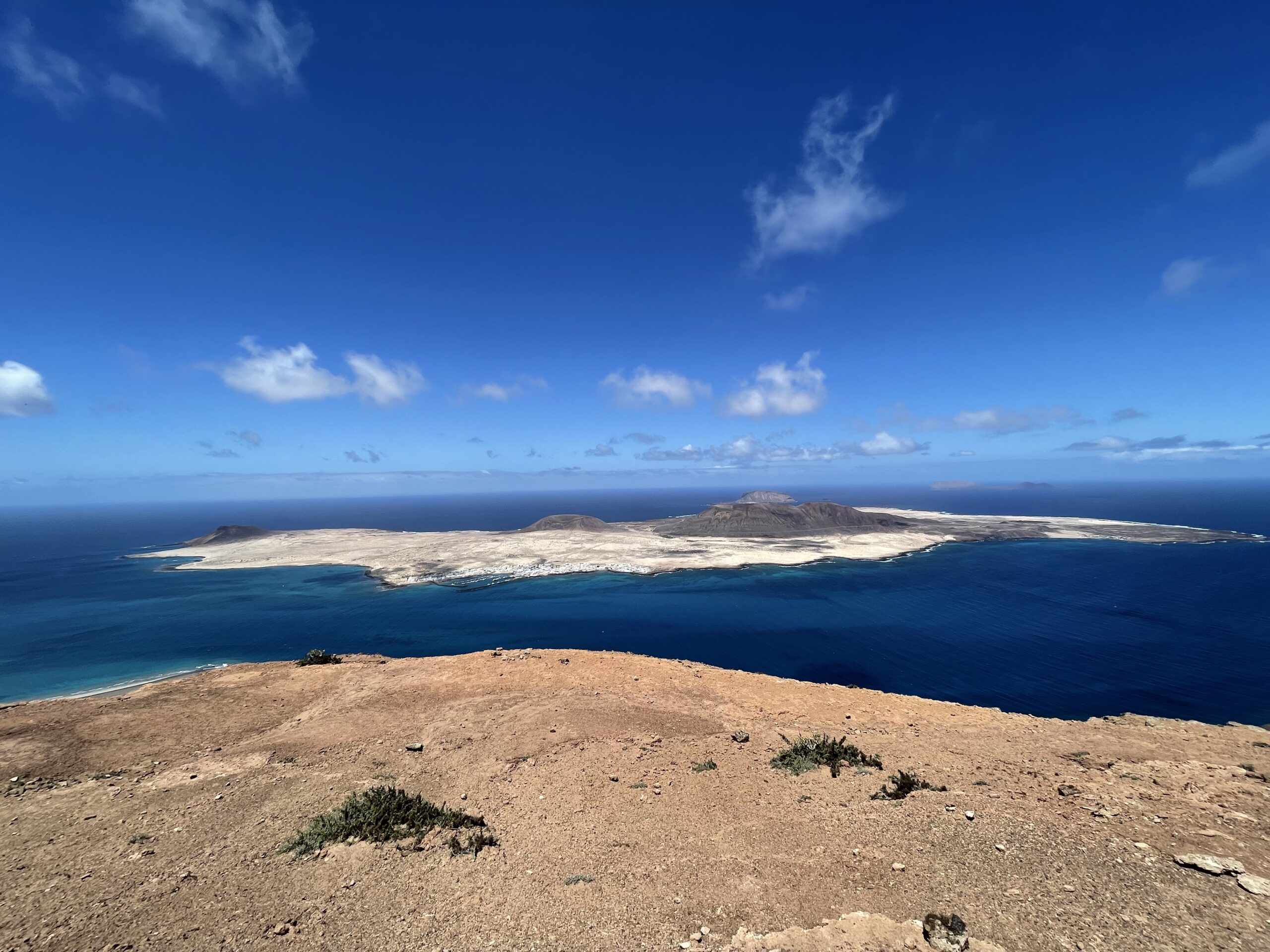


In the evening, I went back to Arrecife to pick up my luggage that I had left at the hotel for the day, before buying some snacks at a shopping mall, getting ready for the long ferry crossing. The Ciudad de Valencia ferry operated by Naviera Armas left at about 11:30 pm, with a scheduled arrival time at 9:00 am in Cádiz, the day after the following day.

I conclude part two here as I headed back to the Spanish mainland after about two weeks of island-hopping the Canaries. I was able to visit six of the seven islands (I skipped El Hierro, a smaller island in the very southwest). However, the trip was not over at this point: after arriving back in Cadiz, I headed west to Portugal. Thanks for reading, and stay tuned for the next part!